OSL Fieldwork Day Two

Tuesday morning saw the sun shining and promised a great day ahead. Whilst the specialists and volunteers got to work on the trenches, Elspeth Walker the landowner and chair of TFG and Dr Ian Parker Heath welcomed a party from Buxton Community School (BCS).
One of the conditions of the FiPL award was that we had a programme of community engagement, and one strand of this was working with BCS to show students how the science they were learning about in the classroom can be put into action in the field, quite literally! Ian had already been into school to talk about the background to the OSL project and the work that had been undertaken over the past ten years.
Matt Jackson who teaches Physics at BCS and a group of nine students arrived early and almost took us by surprise! They were certainly keen to get started with the day. As none of the party had been to Under Whitle before we started with a tour around the farm to familiarise them with the landscape, what work had been done and where. It can be difficult to give people a sense of the topography of a place and Under Whitle has several landscapes packed into a relatively small area. After a break it was over to the specialists and Dr Tim Kinnaird explained the background to OSL and how it worked, what was involved in obtaining samples and the on-site dating method.


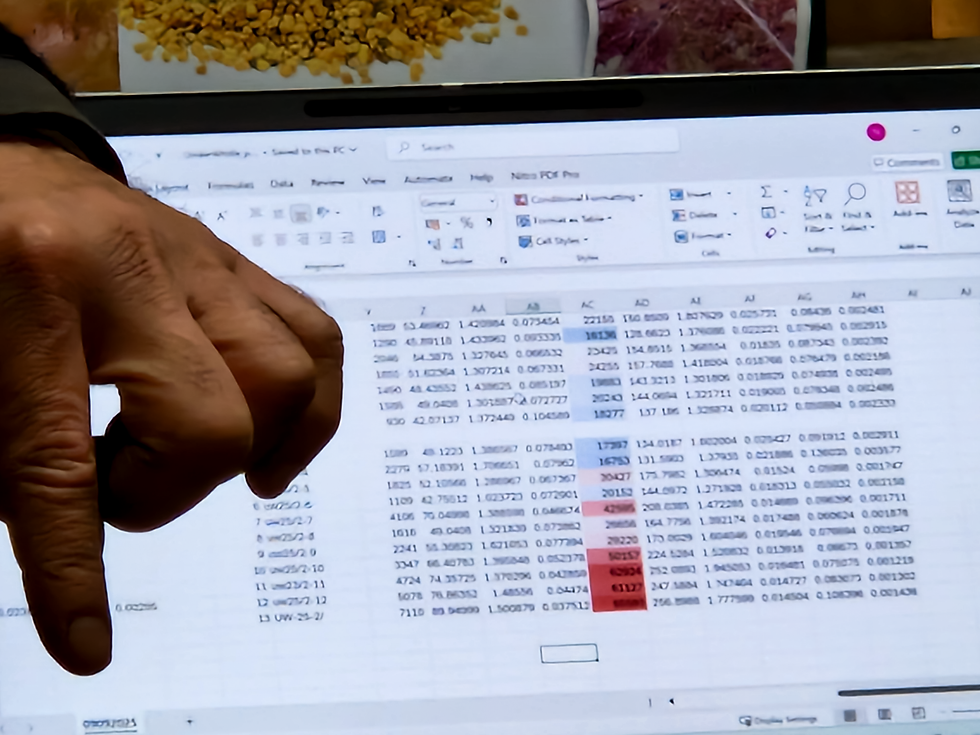
The whole party were keen to know more about the process and of course to have a go. The samples from the trenches are kept in the dark for as long as possible and transferred to testing equipment with a speed that a F1 pit crew would be proud of! The team were using a SUERC Portable OSL Reader to obtain the dating. Each sample is placed in base of the sample reader on the left of the picture. The central box controls the operations and the results are entered on a spreadsheet on the laptop, Different levels of radiation are recorded, including a general background, before the key reading is indicated. The process is monitored on the laptop and the key reading is noted by a sharp-eyed observer.

As each sample's data appears it is entered on a spreadsheet and the software colour codes the results. In the image below, the blues represent younger and the reds older soils. The less intense red tells us that there was 'intervention' in which the soil was turned over whether by digging or ploughing, and exposed to light, which resets the 'radiation clock'.

The afternoon saw the students learning about how archaeologists use global positioning systems (GPS) to locate features, and in this case trenches, tied in with the Ordnance Survey grid. They learned how these tools can pinpoint the corner of a trench for example to within 5mm, rather more accurate than your car's satnav.
The students were a real pleasure to work with, and everybody was impressed by their attitude to learning and their general demeanour. We would certainly welcome them back! Our thanks too to Matt Jackson who facilitated the day.
Elsewhere the work continued unabated with the last of the trenches being opened. We had originally targeted eight features, but trench one proved to be disappointing again this time around. As a back-up a further trench was opened on the lowest of three lynchets in a field known as Main Piece and thought to be amongst the earliest fields at Under Whitle.
All in all it was a great day.


Comments